
A problem exists within our 14-16 curriculum. Instead of offering vocational, technical and creative pathways that inspire all children, it forces a binary pass-or-fail at 16. As a Headteacher, I met children so certain they would fail GCSE maths and English, they expected simply to accept whatever trade a relative could find them. Conversely, a Year 9 student wishing to pursue robotic engineering needs physics, computer science, electronics, design technology. If time-tabling prioritises EBacc languages and humanities, how does this allow the student to follow her ambitions? Industry experience is key, internships, or personal robotics projects so she can develop practical and employability skills. But realistically will this happen in a school setting without college and employer links?
We are disadvantaging all children equally by a single pathway that only leads to the gold standard of university. Those who want to pursue a skilled vocational or creative profession from 14 cannot, whilst those who have similar ambitions, but considered too ‘bright’, are propelled towards university. How is that equitable in fulfilling the potential of all?
A new 14-16 pathways curriculum potentially could restore equity and parity, and meet the Prime Minister’s vision that ‘a hard hat should be as acceptable as a graduation cap’. By incentivising employers, schools and colleges, a pathways-style curriculum could offer real choice, through properly funded apprenticeships, pre-vocational options and work placements. From 2005 until 2011, 14-19 Diplomas attempted this same parity. As HMI Ofsted, I saw firsthand how it re-engaged and enthused children in subjects that genuinely inspired them – motor mechanics, hairdressing, plumbing, catering, electronics – with opportunities to apply their learning in work-related contexts. 14-year-olds following hairdressing finally understood the importance of chemistry and maths, for mixing hair colour!

Success, though, depended on availability of well-qualified, experienced teachers in schools and colleges, as well as access to high-quality resources and well-equipped venues. The linchpin was effective, hands-on local employer partnerships. “Employer champions” drove assignments while collaborative partnerships implemented comprehensive manuals and protocols, all built around local needs. Learners responded with enthusiasm and high attendance, especially when they could demonstrate competence with industry-standard resources. But without employer involvement or off-site visits, over-reliance on theory held many back.
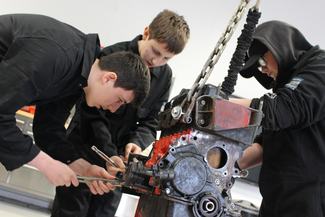
Today’s University Technical Colleges show a similar pattern of employer engagement. Their curricula are designed by university and industry partners, who provide work experience, guide teachers’ professional development and support students into apprenticeships and tertiary education. As Local Authority Advisor, I observed maths, English and science taught through practical, interdisciplinary approaches, leading to technical qualifications in areas like manufacturing and engineering. While leadership quality inevitably shapes outcomes, this delivery model has huge potential to influence the design of 14-16 technical vocational pathways in schools.
Realising this potential, though, means directing structured funding to local consortia – schools, colleges and employers working together on curricula shaped around a community’s needs. The Compass Curriculum | Fylde Coast Academy Trust is a universal Key Stage 4 offer provided to all Year 9 pupils as part of their options selection. It replaces one traditional GCSE with a two-year college course and shows what this looks like in practice, delivering technical and vocational pathways from 14+, blending college, school and work placements. Three Spires Trust’s WMBACC - myFUTURE | Supporting Skills, Careers & Progression is focused on appropriate careers progression and guidance to vocational qualifications for all young people and is currently developing stronger collaborative partnerships with colleges and employers.
However, no reform happens in a vacuum, and we must be mindful of social and economic context. The employment, education and training sector faces a major challenge. 41% of the workforce is overqualified for jobs that exist, while they work in roles unrelated to their qualifications – or do not work at all. Over half of graduates in Cumbria and Lincolnshire work in jobs not requiring a degree. And at 37%, England has the highest level of overqualification among OECD countries. English Workers Lead Global Rankings for Overqualification Compounding the issue, the Milburn Review highlights a growing youth employment crisis, with potentially one in six young people NEET by 2031.
Meeting these challenges head-on depends as much on delivery as on ambition. The Manchester Baccalaureate (MBacc) works well, thanks largely to the city’s diverse employer landscape, local capacity, genuine employer engagement and appropriate funding. This could potentially be duplicated in major cities. But as new strategic Mayoral authorities are granted devolved powers, there needs greater awareness that particularly for non-Mayoral authorities such as Cornwall, Somerset and Dorset, may initially receive less funding. In more remote or coastal areas, fewer employers and SMEs may mean fewer work placements, with poorer transport making them harder to reach. Medway, Kent, Norfolk and Suffolk already have a higher proportion of NEETs than the 4.5% national average.
So for reforms to deliver parity everywhere, equitable access to strong local partnerships needs planning from the outset. Geography isn’t the only barrier – labels matter too. Labelling children as “disadvantaged,” SEN, or EAL caps aspiration by setting a glass ceiling on what is achievable and prod children onto inappropriate pathways. Schools need more than broad averages and vague groupings but need meaningful, valid comparisons that properly account for factors such as IDACI, free school meal eligibility, gender, urban or rural context, attendance and persistent absence. Without that granular detail, we risk relying on generalised narratives that lack the precision to drive improvement.
Other areas, such as careers education and accountability measures must also reflect vocational, technical and employment-linked pathways alongside the academic core. Crucially, these pathways shouldn’t be the preserve of low-attaining students, but prestigious enough to attract higher-attaining ones, too.
Finally, from algebra to technical literacy, many vocational courses demand genuine academic rigour. Many students will need support in English, maths and science. “Stepping stone” qualifications in functional skills alongside financial literacy accreditation, could help support future pathway choices from 14. Our current Secretary of State for Education rightly supports an “education matching high ambition and not a one size all straitjacket.” The curriculum infrastructure we build now must live up to that ambition – not disappoint it, and not repeat the failures of the past.
Written by
Meena Wood, Former HMI (National Lead for Equalities), Principal in Further Education, Senior Local Authority Education Adviser, Headteacher and Author.