An assignment can look excellent and still tell us very little about what the student understands. That's an uncomfortable thought. Generative artificial intelligence (AI) can produce a convincing answer without the student doing much of the thinking we hoped the task would involve. With a new academic year under way, it's a good time to look again at what we're asking students to do. I taught graphic design in further education for just under ten years before moving into higher education, and I've always been interested in how students get to the finished piece. Why that choice? What changed along the way? Those conversations can tell us a lot that the final submission leaves out.
These questions sit at the centre of my doctoral research into assessment authenticity and ethical AI use across further and higher education. My questionnaire, completed by 272 educators, found concerns about whether submitted work reflected students' own understanding. Fewer than a quarter of those answering the relevant question felt their institution's guidance on ethical AI use was clear enough. The findings are preliminary, and the mixed-methods study is still underway. Even so, they suggest a need for support now. Respondents favoured oral explanations and applied tasks, but finding time to redesign assessment was a problem. So was access to training. It's a lot to ask of a teacher who already has a full timetable and marking to get through. Vocational and creative education give us somewhere useful to start.

A graphic design student could bring an early idea to a tutorial and talk through why they abandoned it. Later, they could show how feedback influenced the finished design. The teacher gets to follow the thinking while there's still time to help. We can build these conversations into a task, drawing on the teaching already taking place. Asking for a reflection at the end won't necessarily tell us the same thing. AI can write that too. I'd want to see how the account connects with the work the student developed and the decisions we discussed along the way. That's a better basis for judging their understanding.
Of course, students need opportunities to learn how to use AI where it's allowed. Being able to get an answer from a tool doesn't mean you know whether it's any good. Subject knowledge matters. We might ask students to check an AI-generated response against course sources, then discuss what needs changing and why. They also need to know what information they can safely share and how to acknowledge AI's contribution. And the assessment brief needs to be clear about what's allowed in that particular task. Some assessments need students to work independently under controlled conditions. Others can give them experience of using AI critically in professional work. The decision depends on what we need them to learn and demonstrate.
Making this workable takes support from leaders and awarding organisations. Course teams need time to look across a qualification and agree where students must demonstrate independent competence. They need room to adapt tasks within external requirements too. We also have to think about access. A student shouldn't be disadvantaged because they can't afford a required AI tool, or because a new assessment format introduces a barrier to showing what they know. I'd start with one task that depends heavily on a final submission. What else would help you judge the learning? A planned conversation during the work might be enough to make a useful difference. It's a way to connect assessment more closely with learning and preparation for working life.
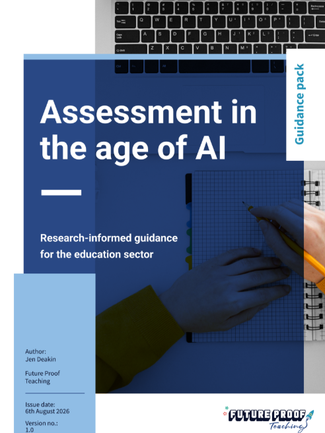
I put together my Assessment in the age of AI guidance pack to help colleagues work through these questions. It draws on research and includes examples you can adapt for your own teaching, including support for ethical AI use. The digital guidance pack is free to access and share. If you'd prefer a paper copy to read and scribble on, a printed version is also available on Amazon.
Written by
Jen Deakin. Lecturer in Digital Transformative Education at Leeds Beckett University and doctoral researcher at the University of Sunderland