The Compass Curriculum: Blueprint for a Universal KS4 Offer
Fylde Coast Academy Trust are fundamentally reimagining what Key Stage 4 education should look like. The result is the Compass Curriculum.
Which is the better flier – a curlew or an airbus A380? How can the sea support positive mental health? Where does food come from and what is its carbon footprint? These are some of the questions asked in the educational resources co-designed by academics from Lancaster University and local teachers from across Lancashire and Cumbria. Reimagining education through the lenses of place and environment, the resources use locality to teach children and young people how to care for the natural world. Education has a key role to play in the fight against climate change, and we believe a place-based approach helps engage students in transformational ways.
The Morecambe Bay Curriculum (MBC) is a teacher-led educational movement which aims to embed place, sustainability and environment into everyday learning. The ambition is that every child and young person around the Bay receives an education which entitles them to learn about the environment in ways that are meaningful and speak to their own priorities and lives. Lancaster University, Lancaster and Morecambe College, University of Cumbria and the Eden Project act as a cross-sector partnership, supporting the growth and future of this movement. Morecambe Bay is a special place that deserves protection, but this will only happen if we develop positive relationships with the environment and learn to value nature.
The MBC supports education to be relevant, meaningful, and enjoyable. Learning experiences should reflect and celebrate the unique identity of Morecambe Bay, its incredible biodiversity, its specific strengths and challenges, and its cultural heritage. By teaching the National Curriculum in ways that link to the local environment, we ensure that young people see the purpose of what they are learning. We’re not talking about plants in the Maldives and flooding in Bangladesh – places that most of these students will never ever go near, we’re talking about Morecambe Bay and plants they might see on their way home so they can have real ownership of it.
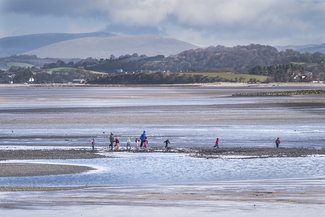
The MBC uses a holistic Head, Heart and Hands pedagogy, going beyond simply teaching factual knowledge.
Head: Drawing on expert research knowledge from universities, young people develop a deep and critical understanding of local environmental issues.
Heart: Through engagement with the local area, they build positive relationships with place, developing empathy and emotional connections to the natural world.
Hands: Students develop the motivation to take action, putting their knowledge into practice and developing vital problem-solving skills. Together this supports children to become active participants in caring for their local places.
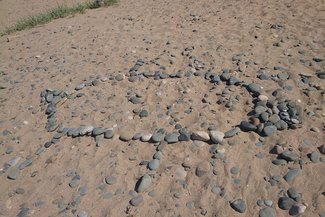
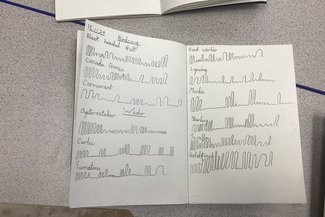
This creative arts resource encourages children to notice features of the beach from different perspectives. Using devices such as macro-lenses or drones, they observe and describe colours, textures and shapes. Photos and images can be used back in the classroom as a stimulus for creative artwork. By ‘seeing and being’ in the Bay, the resource promotes emotional connections between children and their coastal environment. And this cross-curricular resource uses art as a vehicle for teaching scientific concepts of sounds and adaptations. Pupils explore the sound waves of local birds’ songs, creating sculptures of these. They also design models of birds’ feet and beaks, looking at how these support birds in navigating intertidal sands.
Through hands-on, creative tasks, children develop knowledge of what could otherwise be abstract concepts, recognising the wonder of nature. This sequence of problem solving design tasks, for example, teaches construction students about biomimicry and encourages them to find inspiration from the local natural environment. By exploring the construction of local birds’ nests and the intricate patterns of the common orb spiders’ webs, students learn how approaches to construction, design and architecture can be informed by nature.
Our coastline is a dynamic, exciting and special place and education should provide the opportunity to be out there building positive relationships with our sand, sea, saltmarsh and sunsets.
Through the Morecambe Bay Curriculum’s newest project ‘Our Bay Our Future’, more than 5000 local young people are set to gain access to new climate action projects designed to grow the skills needed to care for Morecambe Bay and secure local ‘green jobs’, thanks to a £1.5 million grant from The National Lottery Community Fund. Building on the success of ‘Resources for our Bay’, we have co-designed another series of 10 resource packs in partnership with Our Future Coast.
Join the MBC and be part of our movement for change.
Beth Garrett and Carys Nelkon, Morecambe Bay Curriculum