Employer investment in training in the UK has declined by 29% per employee since 2011, raising concerns about the country’s ability to keep pace with changing skills demands, including digitisation and the transition towards Net Zero. The need for greater employer investment in skills is well-recognised, with the Post-16 Education and Skills White Paper setting out the Government’s intention to work with employers to drive growth and opportunity. However, it lacks detail on how this will be achieved. At Learning and Work Institute we are undertaking research, funded by Nuffield Foundation, to develop actionable policy recommendations on how employers can be incentivised to invest in upskilling and reskilling.
In the UK, you are more likely to receive training if you work for a large company. 69% of employees at businesses with 1,000+ employees have received training in the past twelve months, compared to 63% of those at businesses with 50-249 employees, and 51% of employees at businesses with 1-10 employees. Similar patterns are seen in other countries. Small and medium sized enterprises (SMEs) typically face greater challenges than larger businesses when it comes to training and upskilling their people. These include the cost of training, difficulties in identifying skills needs and relevant training, and challenges navigating the skills system to access training that meets their needs. Looking at other countries gives us some ideas for how SMEs could be supported to overcome these challenges.
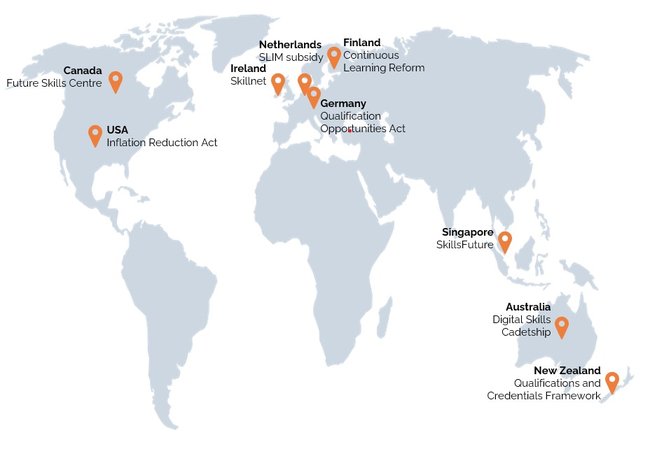
One route is through targeting funding at small businesses. For example, Germany’s Qualifications Opportunities Act subsidises training costs for workers affected by digital transformation or where there is a shortage of skilled workers. Funding tapers with the size of the employer, covering up to 90% of training cost for employers with fewer than 10 employees, 75% for medium firms, and 50% for larger businesses. The subsidies focus on employees with lower levels of qualifications, an approach which may be beneficial in the UK, where graduates are three times more likely to receive training at work than people with low levels of qualifications. Providing financial incentives may not always be enough to help SMEs engage with training though – they may also need support to determine their skills needs and find training. (Click map to expand)

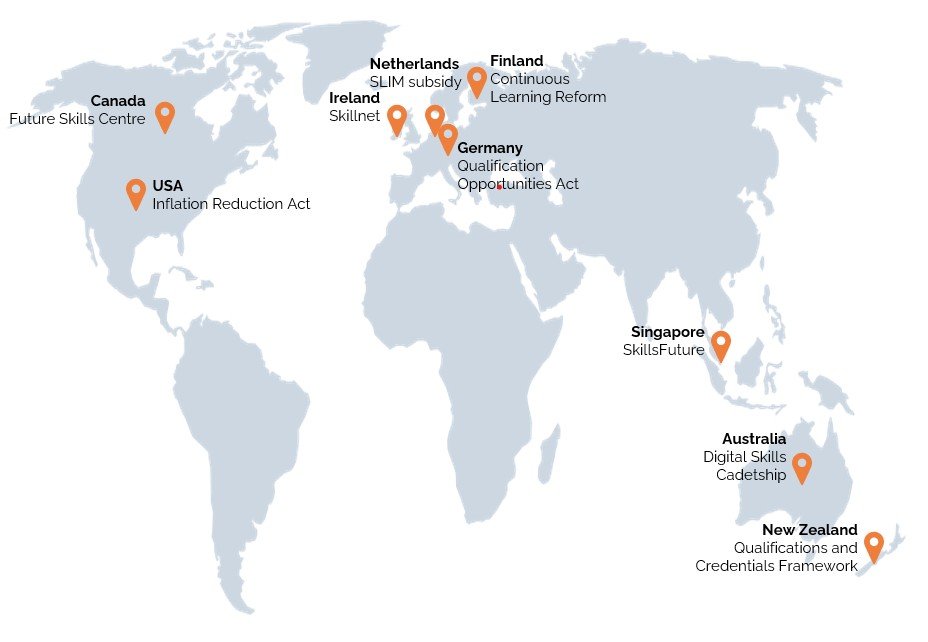
Like the German scheme, in the Netherlands the Incentive Scheme for Learning and Development in SMEs (SLIM) offers subsidised training to SMEs. However, it has found that supplementing this with an intermediary organisation, which provides direct support to businesses with the application process and approaches to training, is important for SME uptake. As part of SLIM, employers also work together in consortia to develop approaches to training, which helps to reduce the administrative burden on individual businesses. SLIM’s interim evaluation suggests that the scheme has also acted as a trigger for strategic thinking about workforce development in smaller companies.
Businesses in the UK increasingly express preference for shorter, modular training. SkillsFuture in Singapore enables short, stackable training, which may have lessons for the implementation of the upcoming Lifelong Learning Entitlement in England. To support information and guidance, SkillsFuture also gives selected employers - designated as Queen Bees – a role in providing support on skills development for growth to other businesses in their sector. The SkillsFuture model is also partly focused on upskilling and training at an individual level, with current and prospective workers encouraged to identify relevant opportunities and training.
The UK is not the only place where SMEs need help accessing training and developing new skills to respond to economic and labour market changes. While other countries’ policies may not be directly replicable in the UK’s skills systems, their approaches to supporting upskilling and retraining can still offer inspiration and useful lessons. This includes the importance of minimising and simplifying bureaucracy; targeting funding to tackle cost barriers; and offering flexible provision that appeals to employers and workers.
To find out more about international approaches to skills and training and their applicability to the UK you can read the full report, and view our comparison framework.

Written by
Dr Bradley Phipps, Researcher, Learning and Work Institute