Island Schools: Leading Global Innovation
Island communities offer a unique setting for young people to grow up and prepare for life and work. But they are also a fertile testing ground for new ideas adaptable to mainland education systems
Edge is expert at highlighting pockets of innovation in education, and nowhere has that work evolved more than within island communities. What began as shining a light on singular examples of best practice has grown into a busy collaboration with Island Innovation and our own Island Education Network. We are able to play a brokering role between unique communities, cross-seeding practice between both geographical islands and figurative ones – isolated communities on the mainland for example. This year, our work took us to the Global Sustainable Islands Summit in Gran Canaria.
Before the summit began, we visited the new ATH Biomethane Plant – a waste-to-energy facility in the sun-baked scrubland of Gran Canaria’s coast. What struck me most was that every single by-product here has been considered, creating a genuinely circular economy. Slated to open in June 2026, the plant will collect organic green waste from local hotels, transforming 95% of it into useful outputs. Biomethane will power on-site vehicles and be sold commercially. Water will be recycled back into the plant or used to irrigate local areas. Meanwhile, CO2 will be captured and sold. Only around 5% of the original waste will end up in a landfill. Running on renewable wind energy and remotely managed by a technology company based in Vienna, the plant is expected to recoup costs within five years
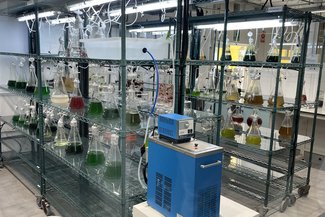
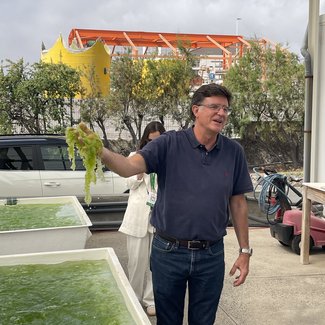
We were also able to visit the Spanish National Collection of Algae at the University of the Canary Islands. Herte, captured CO2 from plants like ATH feeds directly into the research. Their collection holds 2,200 varieties of algae, including those from extreme environments on the archipelago, such as geothermal waters around the islands’ volcanoes. The applications were fascinating, including food production, fertilisers, medicines and environmentally-friendly dyes. They are even trialling algae as a sustainable material for 3D printing! What stood out most was that neither the biomass plant nor the National Collection were operating in isolation from its community. The biomass plant already brings in engineering students and local schools, and similar engagement is taking place at the National Collection. Young people are learning how everything works and can see the jobs of the future taking shape around them. At the summit itself, Konris Maynard, Minister of Public Infrastructure and Utilities from the previous host nation, St. Kitts and Nevis, delivered the keynote. “Islands may be small,” he said, “but we tower – we can achieve big things. We are on the frontline of climate change, but also on the frontline of climate action.”
With the energy crises triggered by conflicts in Ukraine and the Middle East, his emphasis on energy security felt particularly urgent. It could have been sobering. Yet after what we’d just seen, it felt more like the opposite – the solutions are there, they work, and they make economic and environmental sense. Plus, they are genuinely uplifting for the communities that embrace them. A standout session at the summit explored the role museums can play in engaging young people as climate changemakers – connecting communities to their land, heritage and each other.
It drew on the University of St Andrews’ Shared Island Stories project, an exchange between students from Barbados and the Isle of Harris. Students visited each other’s islands and places – in Barbados, a rum distillery and community museum and in Harris, a community-owned wind turbine that sells surplus energy back to the grid, generating income that the community itself decides how to spend. Edge has long championed place-based approaches to education, particularly for disadvantaged young people in former industrial heartlands and rural communities. This session really reframed the role heritage can play in that picture
By focusing not on what they’ve lost, but on what they still have, this approach could be transformative for re-engaging young people who may have switched off from an education that feels irrelevant to their lives.
As two fantastic days came to a close, Edge hosted dinner for education and skills practitioners from across the island network – including a skills lead from the Falkland Islands, the founder of an island school in the Bahamas and a tourism lecturer who advises the government in Grand Cayman. It is great to see our network growing. The thread throughout this summit – while not always explicit – was unmistakably education. Every sustainable solution depends on skilled young people who are engaged and connected to a sense of purpose. And highlighting sustainable solutions is doing some of that work by drawing young people in. The challenge for educators and policymakers is to meet them there.
Susan Higgins, Director of Communications, Edge Foundation.