When educators embody dual professionalism, they are not only experts in their subject areas but also inspirational leaders, says Sarah Bowden.
Strong evidence shows that providing young people with meaningful employer encounters is highly effective in boosting career aspirations and improving social mobility. The government’s renewed emphasis on work experience is therefore welcome, but it also places huge pressure on schools and employers. High‑quality careers support requires careful orchestration and sustained relationship‑building — capacity that schools and employers don’t always have. Six years ago, we launched our See It Be It in Sheffield campaign. We recognised that a busy and fragmented careers landscape was causing missed opportunities between educators and employers, which meant fewer chances for young people to hear directly from employers; what the world of work is like, how to access it and how to thrive in it. The strong evidence showing that four or more employer encounters significantly improves life chances and career choices forms the basis of our call to action.
Sheffield City Council is the Sheffield delivery arm for the Careers and Enterprise Company’s South Yorkshire Careers Hub, which brings together educators, employers and local authorities to collaborate on high‑quality careers education. This collaboration sits at the heart of our model, with our Enterprise Coordinators building strong relationships with educators and supporting them to develop high‑quality careers strategies for their settings. Insights from this work highlighted the challenges schools were facing with employer engagement. There was — and still is — limited capacity to proactively find employers, often resulting in schools cold‑calling organisations with little success. Willing employers did engage, but mainly with schools in areas where social mobility was already high.

To address this, we introduced an employer‑encounter brokerage service as a core part of the See It Be It campaign, making it easy for educators and employers to connect. Educators use their whole‑school careers plans to identify where employers can add value and insight. Good‑practice templates for frequently requested activities (e.g. careers talks, mock interviews) provided a framework for consistency and quality.
In 2021/22 we produced our first impact report: 377 business volunteers enabled 10,283 young people to have an employer encounter. This was strong reach — but not always to the young people who needed it most. With a shared belief that talent is everywhere but opportunity is not, in 2024 we joined forces with Business in the Community’s (BITC) Pride of Place Programme to expand our approach. Through this partnership, we more than doubled our reach, attracting over 600 business volunteers who supported, inspired and informed more than 25,000 young people. Crucially, most activity was directed towards areas of high deprivation across the city. This growth was driven by businesses championing the campaign and encouraging others to get involved.
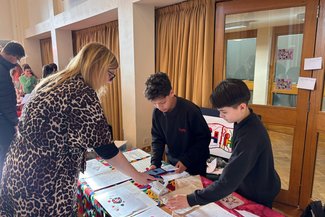
It soon became clear to BITC that the model could be replicated in other areas delivering Pride of Place activities. See It Be It is now being rolled out in Coventry, Newport, Rochdale and several other areas nationwide — a strong sign that the model works. We learned early on that cold‑calling businesses would never achieve our ambitions. Good volunteering initiatives benefit the volunteer as much as the programme, which is why we invest time nurturing employer relationships. This means understanding employer motivations, supporting them to engage confidently and connecting them with other local businesses and initiatives. It is resource‑intensive, but these relationships matter.
Most employers begin with one engagement activity. We work with them to understand their capacity to do more and to get involved in deeper, longer‑term opportunities such as workplace experiences, teacher externships or governor roles. My recent MBA research surfaced something important: while we often categorise businesses as ‘small’, ‘medium’ or ‘large’ and make assumptions about their capacity to engage, our experience shows that it isn’t the size of the business that matters — it’s the size of their hearts. Large businesses with significant capacity may do little, while small businesses often contribute an enormous amount simply because they are passionate about inspiring the next generation. While digital systems help, they cannot replace real relationships, nor understand the nuances, politics and stakeholders in each area. As BITC expands the model, we are learning that while some elements — such as brokerage frameworks and templates — can be replicated, the approach must also adapt to local microclimates. The human element is critical to navigating and understanding local landscapes.

Evidencing impact is challenging and this can make it difficult to secure funding for this very valuable addition to the careers landscape. Despite strong evidence for the value of four or more employer encounters, longer‑term effects are difficult to capture. The impact of our activities often emerges months or years later, when young people reflect on those ‘magic moments’. Yet funding partners frequently require hard data within short timeframes. Current funding mechanisms typically focus on outputs within three to six months — unrealistic when working with children from primary school through to leaving age. Adopting a social value investment model could transform our work, enabling long‑term investment and measurement across years, not months. If I were advising another area exploring this approach, I would offer two suggestions.
First: make it as easy as possible for your stakeholders — hide the wiring. When the process feels simple, they are far more likely to engage. Second: remember that just because impact is hard to measure doesn’t mean it isn’t happening.
My team jokingly measures success in “warm fuzzies” — that feeling when a young person’s face lights up. These intangible, human moments matter just as much to volunteers as they do to young people and teachers. None of this would be possible without educators, employers and partners working together. Our team works hard to broker these relationships, but the real difference comes from the commitment and passion of those involved in levelling the playing field for young people. As our model expands to other regions, I’m reminded that at its core, this is about people helping young people to thrive. And that is something absolutely worth measuring in “warm fuzzies”.
Cheryl Plant, Pathways & Progressions Manager, Sheffield City Council.