Our mission is to empower young people to embrace learning, unlocking both academic and vocational success.
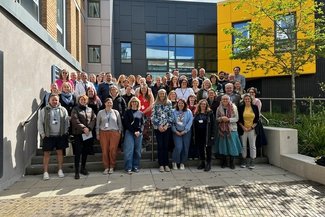
Eighty senior education leaders from across the UK and beyond gathered in Lancaster over three days in May for the Deeper Learning UK conference 2026 (DLUK). We visited schools and colleges, heard from like-minded colleagues, networked and strengthened the connections that make this community so valuable to those aiming to transform education. This year’s event was hosted by Lancaster University and Fylde Coast Academy Trust (FCAT), the organisations behind Morecambe Bay Curriculum and Compass Curriculum and we can’t thank them enough.
Activities began on Thursday with a learning safari which formed the centrepiece of the conference. Three coach tours set out across the region, taking delegates to Ripley St Thomas Church of England Academy, to Lancaster and Morecambe College, to Blackpool and The Fylde College, and to Myerscough College. We met young people learning farming, building rally cars, working in hair and beauty salons and caring for livestock and smaller animals, including a tiny Caiman – all with evident confidence and purpose. George Kearney-Bambridge, CEO of Envision, quoted a student saying of traditional education: “You expect us to think outside the box, while putting us in one.” An excellent summary of exactly what DLUK exists to change.

FCAT’s Compass Curriculum drew particular interest. By taking Year 10 and 11 students into FE college once a week, it creates a clear transition between KS4 and post-16, catching many young people who would otherwise slip through the net. FCAT’s own data shows that Compass has also resulted in a 75% reduction in behavioural incidents at school Robbie Kirkman, Education Team Lead at Eden Project Morecambe, rounded off the first day with a powerful presentation. He reminded us that the Morecambe Bay and Compass Curriculums are part of a much wider vision for this region – one rooted in nature, community and place.
On Friday, we discovered just how far the network has come since our last gathering. I led a discussion with Edge Senior Policy Advisor, James Gordon, on the policies that are helping and hindering work across the four nations. Colleagues from Stoke and Staffordshire made a compelling case that building inclusive post-14 pathways does not require waiting for national policy to first shift in our favour. The afternoon came to an end with a member carousel showcase, with practitioners sharing work in areas including expeditionary learning, the International Baccalaureate and the Extended Project Qualification. It was genuinely uplifting to see just how far the network has come. We are no longer simply talking about what’s possible – the work is underway and its impact is increasingly hard to ignore.
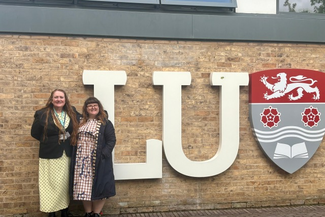
This growth is visible within our own community. Marcelo Staricoff, who attended his first DLUK conference in 2024, returned this year as a contributor, leading a session on the Joy of Not Knowing and sharing international work with colleagues from Kazakhstan and Uzbekistan. The sense of a movement coming into its own was captured by Tina Schuster, who flew in from High Tech High in San Diego. We often jokingly describe this community as a Rebel Alliance, and Tina had just attended a major deeper learning conference in the USA, where she met Ron Berger, pioneer of the expeditionary learning movement. Ron was wearing a Rebel Alliance pin – Tina asked him for it and then brought it to me in Morecambe Bay. A small, tongue-in-cheek gesture, but also a reminder that DLUK is part of something truly international.
One of our first-time delegates was Rebecca Torrance Jenkins. Rebecca, who has a background in neuroscience, is setting up a new secondary school in Bath, set to launch in September. She described finding DLUK as something of a relief, “This work can be a lonely thing. You feel like you’re the only one doing it, and then you arrive somewhere like this!” Rebecca explained how the Compass Curriculum gave her confidence that the model she is developing can work at scale. She has already been collaborating with Rosina Dorelli on the Da Vinci Life Skills Curriculum, but the conference has created new connections and potential funding streams to support their work. She met Phil Avery from the Bohunt Education Trust, who has expertise in setting up state secondary schools.
“We were aligned in many ways, but also had a great discussion, with differing views. That’s the value of the network. Even with differences, we are working towards the same goals.”
Phil had some friendly critical questions about Rebecca’s school setup. These proved so useful she asked him to become an adviser for her school, which he accepted. “Perhaps my weakness is that I'm a massive optimist. But I hope he will point out the flaws. I think he will bring a dose of critical reality in a really supportive way.” As I told Rebecca, I hope that DLUK can become her new home, which is true for any new member. I believe, that for many first-timers, that’s exactly what the network is. I can’t wait to see what next year brings.
Olly Newton, Executive Director, Edge Foundation.